Monday, 12 March 2012

Alternative models: Macross Valkyrie jets

Like a lot of 15mm players I try to keep an eye out for interesting toys and scale kits that could be used for gaming. Browsing stores like Hobby Link Japan can turn up some really interesting finds. If you're not averse to the sleek anime-look or most of their models, you can find a plethora of mecha in various scales, including our own 1/100, and sometimes other types of models.

A few weeks ago I stumbled upon a selection of 1/100 scale jets. Apparently they come from a series called Macross and transform between jets, jets with legs and normal-looking mecha, but these particular kits are "stuck" in jet mode.

 Now, there are two obvious issues with aircraft in 15mm. Firstly, they're a fair bit bigger than tanks and can overshadow the rest of the models. Some games (like Flames of War) get around this problem by using undersized aircraft, but this just feels weird to me. Second, at 15mm scale the table still represents such a small area of ground that it would be unrealistic for a fixed-wing craft to stay on the table for any length of time. Knowing this, I still decided to buy a kit and see for myself. The one I opted for is cheap enough and looks good enough that I wouldn't be too sorry if it turned out to be useless for 15mm and had to be relegated to the display cabinet.

Using HLJ's cheapest "it ships when it ships" option I had to wait a little bit over a month to get my order.


The box contains 3 sprues, an instruction sheet in Japanese (but illustrated well enough that assembling the model was completely unproblematic) and a large sheet of stickers.


Bandai uses some serious wizardry to make multi-coloured sprues in a single mold. Combined with the sticker sheet, this means that the model can be displayed as an anime memorabilia piece without any painting. A serious modeler or gamer will still want to paint it properly, though. Similarly impressive is that the model snaps together without any glue and all the parts fit perfectly.


Despite being advertised as 1/100 scale, the pilot is a fair bit smaller than my 15mm GZG infantry, even accounting for the New Israeli's hardsuit. If I decide to use the jet for gaming, I'll have to paint over the cockpit to hide the little man.


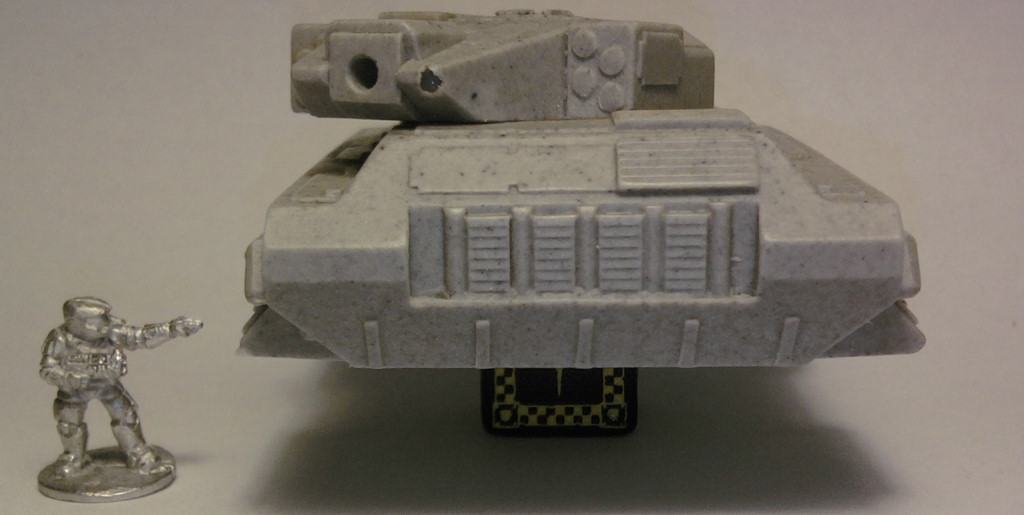
And a size comparison with an Old Crow Sabre, which is one of their heavier tanks.The size difference is realistic enough, and I don't think that a single jet would look too off on the table, size-wise. As for the other issue... well, in a world where grav tech exists, it cannot imagine that it wouldn't be used on jets, at least as a secondary system to provide easy VTOL and a safety net in case the main engine dies. This would make every jet capable of hovering and providing fire support for ground troops in the same way helicopters can today.


Even if your setting does not allow you to hand-wave these issues away with grav tech, the model still makes a fine terrain piece or objective, or can be used as an "instant death" ending in scenarios (you have to complete your mission before the jet arrives and bombs your forces).

I would not recommend it to everyone, but if you like the design aesthetic you might want to give it a shot. It cost me a about $20 US with shipping from Japan, which is a competitive price even compared to lower-quality local offerings (Revell, Italeri...)

Friday, 9 March 2012

Game Theory, part 3: Stats

Well, looks like Friday has officially turned into Game Theory day on 1%FUTURE.

This week I want to discuss stats and associated design parameters. By stats I of course mean the different attributes that games use to track the capabilities of individual models, such as Strength, Defense, Morale and so on. I find that this, too, is a very important aspect of game design and I have personally been turned off to many game systems because of an unappealing statline.

One of the core aspects that can determine the feel and style of a ruleset is simply the number of different stats possessed by each model, and there is a decent amount of variation between systems in this regard. Rulesets with lots of stats are said to be more detailed (obviously) and often thought of as being more realistic (although I personally find this assumed correlation between detail and realism tenuous at best) and tend to be marketed more towards "hardcore" gamers while systems with few stats are assumed to be simplistic and aimed more at "casual" gamers (whether this distinction actually exists is another question altogether).

Besides the actual number of different stats it is also important to note the range of possible values for each stat. These two factors together effectively determine the amount of real variation that is possible between different models in the game. The well-known game Warhammer 40k has no less than 9 base stats, but most of them actually have a range of only 2 or 3 possible values for regular soldiers, meaning that the differentiation between models is actually a lot less than it seems to be at first glance. However, with such a small range of values, any difference is actually meaningful. An extra point of Toughness has a huge impact on the game, while one point either way is barely noticeable in a percentile system (where values can often range between 1 and 100).


A crucial aspect of a game's appeal is the way the stats are presented. I have closed and deleted many pdfs ("indy" games often seem to have more trouble with good presentation) when a quick glance at the sample unit profiles revealed a large, plain chart filled with meaningless (for anyone who hasn't pored over the entire document in detail already) numbers and acronyms. It is clear that I am not alone in this, as almost all recent games have adopted the use of visually appealing statcards for individual units and/or full-page spreads for each unit where the statline is accompanied by illustrations and background information to break up the monotony of what is essentially a string of numbers.

The number (and value range) of stats in a game obviously depend chiefly on the designers' desired level of detail, but other considerations should also be made. Presentation, as mentioned above, is important. Long statlines can look intimidating and dissuade players from even attempting to learn the game. Designers should always examine every stat and determine whether it really contributes anything to playability or is just cluttering up the statline. As an example, the Wounds stat in Warhammer has a value of 1 on every model except for the greatest heroes and huge monsters. This creates the illusion of variety when in actuality the Wounds stat is completely superfluous on almost all models. It would be simple and effective to remove the stat altogether and replace it with a special rule that only appeared on those mighty hero and monster models. This would reduce the length of the statline for regular models, making it more readable, without taking anything away from the game.

From the players' perspective, there is probably no such thing as the perfect statline. Some might gravitate towards shorter or longer statlines, depending chiefly on how detailed they wish their battles to be. Some people might desire the inclusion of a specific stat so that they can properly represent a certain army they have in mind. A player who is dead-set on playing agile space elves, for example, will probably look for systems where their characteristics can be represented in some way - perhaps through Maneuverability, Evasion, Initiative or other similar stat. In this regard it's impossible to please everyone, and games that try usually fail the hardest.

Designers should have clear goals in mind when designing statlines. The role of each stat should be carefully considered and stats should not be added simply to cater to specific types of players or factions (that's what special rules are for) or to create a fictitious appearance of variety. Each stat should have a clear and important function in the game rules that could not be replicated with other kinds of abilities. As long as the stats are presented intelligently and mesh well with the rest of the rules, I think most players will be willing to give it a go, even if they would personally prefer a longer or shorter statline.


So, what are those measurable model attributes that usually take the form of stats in a game system? Off the top of my head, I can think of a fair few that seem to crop up in almost every system:

Movement: some games have standardized movement values, usually depending on unit type, while many games have individual movement stats for all models. Is there a right and wrong way to go here? There are many complaints about 40k's standardized 6" movement but I think it meshes well with weapon ranges (all multiples of 6) to create an interesting, fluid and intuitive system of ranged and melee threat ranges (which then breaks down because of special movement abilities that add a random value to a unit's speed).

Attack Skill: often split into melee and ranged ability, but rarely omitted (Flames of War being a noteworthy exception). Determines a model's chance to hit its target. Sometimes it depends entirely on the attacker's ability, sometimes it is opposed in some way by some sort of Defense Skill.

Attack Power: determines the chance of a successful strike damaging the target. In extremely streamlined systems Attack Power and Attack Skill can be combined into a single stat. In many systems, Attack Power is opposed by one or more abilities representing the target's Resilience, sometimes split between its natural toughness and artificial armour, sometimes combining the two. In more detailed systems, Attack Power is often assigned to individual weapons, not models as a whole (although models might also have an Attack Power of their own to represent unarmed attacks) and different parts of a model might have their own armour values.

Morale is also present in almost all games under one name or another, sometimes also incorporating other aspects of training and leadership, such as the maximum range at which a commander can order his troops.

Damage Capacity is expressed as a stat in some systems (as wounds or hit points, for example) but is handled by other mechanics just as often (damage tokens, damage boxes, disabled systems...)

Besides these common attributes there is a slew of others that are included in some systems but not others. Aspects such as perception, reaction speed, magical ability, energy shields, maneuverability, size, intelligence and many others are covered by one system or another depending on the desired complexity level and the specific needs of the genre and setting.

Well, that's all that comes to mind right now. I'd like to know if I forgot to cover any important attributes in my list above. Speaking specifically about 15mm sci-fi systems, are there any other stats you think are important? Do you know of any systems that are a radical departure from the above? Do let me know.

Ta ta!

Thursday, 8 March 2012

Microupdate: Old Crow Progress

One afternoon after reviewing my latest Old Crow order I'm about halfway done with cleanup and assembly.

The single-piece scout vehicles weren't much of a challenge, of course. It took me a few minutes to fix the uneven sanding on the grav scouts. I must say that Old Crow resin sands really nicely.


 I spent a while trying to bend the grav plates for the Glaive and Gladius with limited success. The resin does soften up a little bit when heated but remains largely elastic (meaning it snaps right back into its original shape). In the end I assembled the tanks by heating up the resin and gluing the parts together while they were a bit bendy. Considering how strongly superglue bonds resin, there is little fear that the bits could bend back and come apart.


 The Lancer actually took less work than expected. I did have to sand down the armour plates a bit, then I heated them up before gluing, just like I did with the Glaive/Gladius parts. There is just some gap filling left to do now. Once assembled, the heavy APC looks like a really mean piece of kit, larger even than the Sabre. When I first examined the parts I did not think that I would ever want to buy another one, but now that it's assembled I think it's worth the extra work.


Well, that's all for today. I'll post the other half when it's done. Ta ta!


Wednesday, 7 March 2012

Old Crow Reinforcements

Like I said at the end of my initial Old Crow review, I placed another order that same day (the 14th) and it arrived on the 5th, 20 days later - two days faster than my first order.

The packaging is again commendable, with each vehicle individually bagged and the entire batch encased in bubble wrap and packing peanuts.


Going roughly from smallest to largest, let's start with the Goanna Scouts. These come two per pack and are really nice sculpts, especially for single-piece models, but I would prefer separate wheels. I feel the block of resin that extends to the floor is a bit too much of a compromise, simplifying casting at the expense of aesthetics.


As with all Old Crow models, the underside is sanded flat, but unfortunately one of the Goannas does not lie level with the ground, looking perhaps is if the tires on one side were flat. Apart from that, the casting itself is every bit as flawless as I came to expect.


Second come the Outrider scouts. I opted for the grav version but Old Crow also offer them with hover-skirts or wheels. I was pleased to note that each vehicle comes with a choice of gun turret, missile turret or access hatch. This leaves me with some spares for the Goannas (which come unarmed).


Sadly the sanding is again uneven, as can be seen on the following image. Note the different thickness in the grav "flaps" on the two vehicles.


Next up are the Trojan APCs. These look very much like Slingshots but come with single-piece hulls and yet more spare turrets.


Unfortunately the casting on these is considerably worse than the other Old Crow models I've seen. The underside of one vehicle is absolutely pitted with bubbles and a fair few smaller ones extend to the sides of the hull, as well. Looking at this model reminds me strongly of GW's ironically named "Finecast" range.


Well, moving on to the Gladius grav tanks. Their hulls come in an upper and lower half, but unlike the Slingshot the pieces are not joined with the sanded sides, instead the sanded side of the upper hull goes on the smooth side of the bottom piece.


The bottom halves aren't cast perfectly flat, so there is a bit of a gap at the join. Since the piece is fairly thin, this can probably be easily fixed with a little heat-bending.


With the addition of a standard tank turret the Gladius makes for a really nice grav tank.


The Glaive APC is based on the same shape as the Gladius and uses identical lower hull pieces. Again, those are a bit warped. The Gladius comes with yet more spare turrets.


At this point I finally remembered to place an infantryman  in the shots to give a sense of scale. The Gladius is really chunky and looks like it could fit 10-12 soldiers in full gear quite comfortably.


The Sabre heavy tank comes in one piece plus turret. Its turret is much larger than the others and is the only one not compatible with the rest of the range.


The details are good and the sanding seems fairly level here. The hull is cast well but the turret has one huge bubble up front.


Once that is filled, the Sabre will make a really impressive main battle tank. I really will have to pick up a few more.

One thing to note about all these grav vehicles is that, with their bottoms being sanded flat, you are left completely to your own devices if you wish to mount the vehicles on any sort of stand or base.


After all these one- or two-part hulls I was quite surprised to find that the Lancer APC comes in 7 parts.


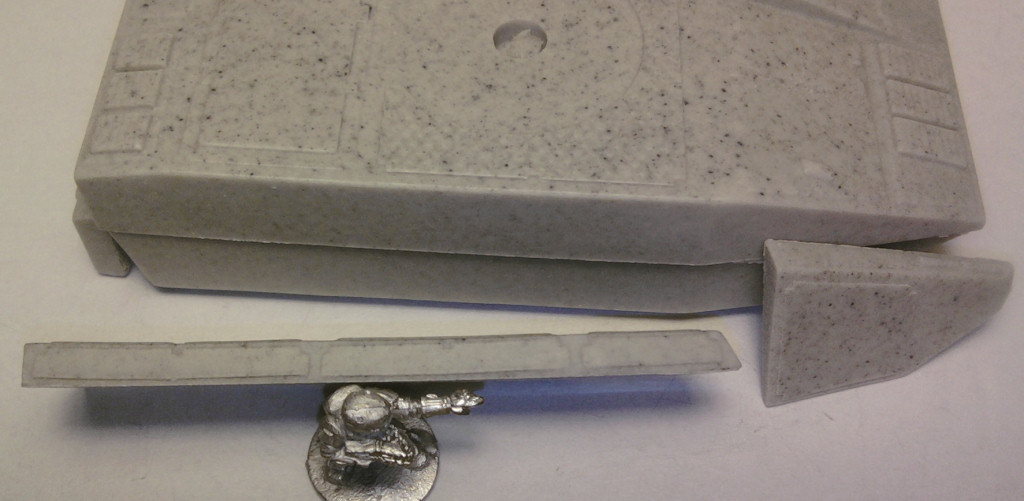
The top and bottom hull piece join with their sanded faces. The bottom piece is hollow, probably to save on resin, or perhaps so that an upside-down Lancer can double as a jacuzzi. The bottom hull is a little smaller than the top and I'm not sure whether this is due to uneven shrinkage or perhaps intentional.


The armoured panels attach to the sides, but came noticeably warped. The curvature is very obvious in this top-down picture. To compound the problem, the warping happened before the back was sanded flat, so if I bend the panels so that the detailed side becomes flat, the sanded side will curve. The Lancer is definitely  the "expert level" kit of this batch much like the Crow Lander was in my previous order.

(Update: assembling the Lancer was actually easier than expected)


I also got a "Comcen" turret for the Lancer. It has a simple but effective design, with a chunky support structure and a simple dish.


Lastly, Old Crow threw in a hand-signed note and two infantrymen as a freebie. These compare favourably to GZG's New Israeli (far left). The detail is considerably sharper and the metal looks to be of higher quality. Unfortunately the mold lines as every bit as heavy as GZG's.


And here is everything an hour later, after being scrubbed in detergent to remove any release agent. The parts did not feel at all greasy and it's possible that this step was unnecessary, but it's always better to err on the side of caution. You only need to see the paint peel off one model to never risk it again.


Based on this batch, I'm afraid I have to dock Old Crow a point in Casting (down to 9/10) as there were some quality control issues (uneven sanding, excessive bubbles on one vehicle) but so far these are still the exception and for the most part the casting remains well above average for resin models and I will happily place another order with Old Crow very soon.

Tuesday, 6 March 2012

Microupdate: GZG New Israeli infantry collection

Today I was sorting my new collection of New Israelis, thinking about how to configure my units, and I found the view just too nice not to share. This is, I think, a little over 100 guys. It may be a bit more than a lot of readers are used to, but since I'm the first person to start a 15mm army in my parts, I need an army that's large enough that I can lend half of it to an opponent. Hopefully I'll rope in some more players soon, ha ha.


A - two mortar teams (gunner and loader)
B - four Gauss MG teams (gunner and loader)
C - four lone spotters
D - six hacker teams (hacker and 2 grunts)
E - four infantry squads (leader, heavy energy weapon, comms, 3 grunts)
F - four infantry squads (leader, missile launcher, comms, 3 grunts)
G - six spotter teams (spotter and 2 grunts)
H - two lone snipers

That's it for today. Ta ta!

Sunday, 4 March 2012

Alternative miniatures: Matchbox Mission Copter

Some readers are no doubt already aware of this little gem. I believe I first saw it on the TMP forums.

I did not pay it much attention then, but a few days ago I stumbled upon the models in a local toy shop and after turning a box over in my hands for 10 minutes, I snagged up all three they had in stock. I will not show the packaging because it changes from year to year (as does the paintjob - just make a Google image search for matchbox mission copter) but this is how it looks inside its little box. At first I was confused by its short tail, but as it turns out, it actually extends to a more reasonable length.


Size comparison with a GZG New Israeli and a Slingshot AFV from Old Crow. Even with the tail boom fully extended, the mission copter is honestly a lot shorter than any real life helicopter I know of, but at least it looks like it comfortably sits two people, more if they're a bit cramped.


The model does not include any weapons although it has some obvious weapon mounting spots. A few spare miniguns or missiles will be required to make it look proper.


I'm not quite sure what I'll do with my little squadron. I would like to extend the tail booms more, but it looks like it would take a lot of work. It probably won't bother me enough not to use the models at all, but if it comes to that, well, they only cost me a few euros, so whatever.


If anyone has done something worthwhile with these little things, please let me know. Ta ta!

Friday, 2 March 2012

Game Theory, part 2: Dice Mechanics

I hope you enjoyed last week's ramblings, because here's some more. This time I want to share my thoughts on dice. Ah, dice. With a scant few exceptions, dice are at the very core of the games we hobbyists play and many of us develop a strange, sometimes obsessive fascination with them. For many, an agreeable dice mechanic is central to the enjoyment of any game system, and it's no wonder that game designers have come up with an endless variety of ways to add up the score. Why don't we look at some of them?


Roll under: This is one of the most basic dice mechanics of all. You roll one or more dice and succeed if you roll less than a certain score - typically less than the ability value of your model. This method is dead simple but annoys many people because lower scores are better, which can seem counter-intuitive. It is also very difficult to combine with opposed rolls or other variants and has limited space for applying modifiers unless really large scores (and suitably large dice) are used, such as percentile dice. Infinity does manage to pull it off, requiring your roll to be below your ability value, yet higher than your opponent's roll, but I feel this makes it somewhat too difficult to eyeball your odds on the fly.

Target number: In many ways, this is the exact opposite of roll under. You roll your dice, add the relevant ability score and whatever modifiers apply and check whether you beat a certain number. If the target number is always static, this method is mathematically the same as roll under, but more intuitive because high rolls are better. This is perhaps the most common dice mechanic, with the target number often depending on some characteristic of the target. Warmachine is a great example: an attacker rolls 2d6 and adds his attack value, and succeeds if he beats the target's defense value. Warhammer also uses target number rolls for most of its mechanics, although here nothing is added to the die score, which is directly compared to a target number that is usually given in a table and depends on the relative values of the attacker's and defender's abilities.

Dice pool: This method is reserved almost exclusively for roleplaying games as the large numbers of dice rolled per figure make it unfeasible for massed combat. In this system a model's ability value usually tells you how many dice to roll for a given check. In this case, the target number does not represent the value you need to beat with your dice total, but the number of dice that have rolled over a certain value. For example, you might roll four d6 and require at least two of them to score a 5 or better in order to succeed. Dice pools are fairly flexible because you can alter the number of dice being rolled, the type of dice, the number of successes required and the score needed on each die to count as a success.

Opposed rolls: As mentioned in my last post, this method has both players roll dice and apply whatever bonuses they have, and the player with the higher total score wins. In effect, your target number is equal to your opponent's score.

Of course all of the above options have numerous variants and nuances. Another way to differentiate a system is with different types of dice. The standard die types that should be familiar to anyone who has been in the hobby for any real length of time are the d4, d6, d8, d10, d12 and d20. We all probably feel most at home with the humble d6, since it comes with just about every classic board game from Snakes and Ladders to Monopoly. It is the most commonly available (although, to be honest, anyone reading a 15mm gaming blog should be more than resourceful enough to procure large quantities of the other types easily) and the easiest to read, even when rolled in large handfuls. You should not discount the other die types, however. The larger the die type, the wider the range of results it can provide (duh). This can allow for a greater range of possible ability scores on your models, as well as more modifiers. For example, a game system that uses only d6 cannot have a difference greater than 6 between the lowest possible ability score and the highest possible target number without making some models completely incapable of succeeding at some tasks.

It is also possible to use die types to adjust the odds of success instead of changing target numbers. In some games, die types are used in place of ability values themselves, an inept model having an attack stat of d6 and a skilled model having a d10, for example. On the 15mm scene, Tomorrow's War is the best known example of such a system.

Another aspect we can look at is the probability distribution of the die results. This is usually linear if you use single dice (the odds of rolling a 1 and a 6 on a d6 are identical as long as the dice are manufactured properly). If you add up the score of several dice together (such as in Warmachine, where you roll two or three d6 and add them up) you get a bell curve distribution, which means that average scores actually come up more often than low or high rolls. Another way to tweak distribution is to put the same score on several facings on one die; a d6 marked 1-2-2-3-3-4 instead of the usual 1-2-3-4-5-6 obviously rolls a 2 or 3 more often than a 1 or 4. Making custom dice might seem out of scope of the average gamer, but it's honestly fairly simple (I think I have a topic for another article right here!) You can tweak the results further with concepts such as critical hits and "exploding dice" (adding another die to the roll if the first roll scores a certain result) but keep in mind that these things can really complicate the math and make the game much harder to predict and balance.

So what are my personal preferences here? I have tried many systems and enjoyed most of them, but I find that I dislike rolling under, as I prefer high numbers to be better. But on the whole I would say that I do not care much for the exact method of rolling dice as long as the method chosen is consistent.

What do I mean? I'm saying that every die roll I am supposed to make during the course of the game should follow the same logic. If we're going for dice+value vs target number for attack rolls, that's what I want to use for morale tests, as well. Why are morale tests roll under? That's bad game design to me. Warhammer in particular has an obscene amount of different dice mechanics, so why don't we look at some of them?

1) Ranged attacks: straight d6 roll, target number is 7 minus attacker's ballistic Skill
2) Melee attacks and Wound rolls: straight d6 roll, target number is given on a table, depends on relative Weapon Skills (or Strength and Toughness) of the attacker and defender; but the two tables are different
3) Armour saves: straight d6 roll, target number is equal to model's Armour Save score
4) Armour penetration: d6 roll + strength of weapon, target number is vehicle's armour value
5) Difficult terrain roll: roll 2d6 and pick highest, result is the distance you can move
6) Leadership tests: straight 2d6 roll under Leadership value
7) Characteristic tests: straight d6 roll under characteristic value (Strength, Toughness, Initiative...)
8) Sweeping advance: d6+characteristic value opposed rolls


That's 8 just off the top of my head and not counting any faction-specific abilities. We have loads of different varieties of target number rolls, one opposed roll, one roll under, and three different distribution patterns (linear, bell curve and something weird for the difficult terrain roll). At least they all use d6.

I haven't encountered any other games that are quite so extreme but most do have at least a few different mechanics. Morale tests seem to be the most common offender, often having a mechanic of their own even in otherwise fairly consistent systems, such as Warmachine and Gruntz. In Infinity, armour saves work exactly opposite to every other roll for no good reason.

To conclude, regardless of your preferences, I suggest you be wary of games with many different types of dice rolls. It's a good sign that the core dice mechanic of the game is so bad that all the rest had to be tacked on to cover situations where the standard one just doesn't work. That's how I see it, at least. Feel free to share your opinions below, along with any other dice options I might have missed. Ta ta!